AMR Leasing vs Buying
AMR Leasing vs Buying We’re being asked to do more with less, to be more flexible and quick to adapt,...


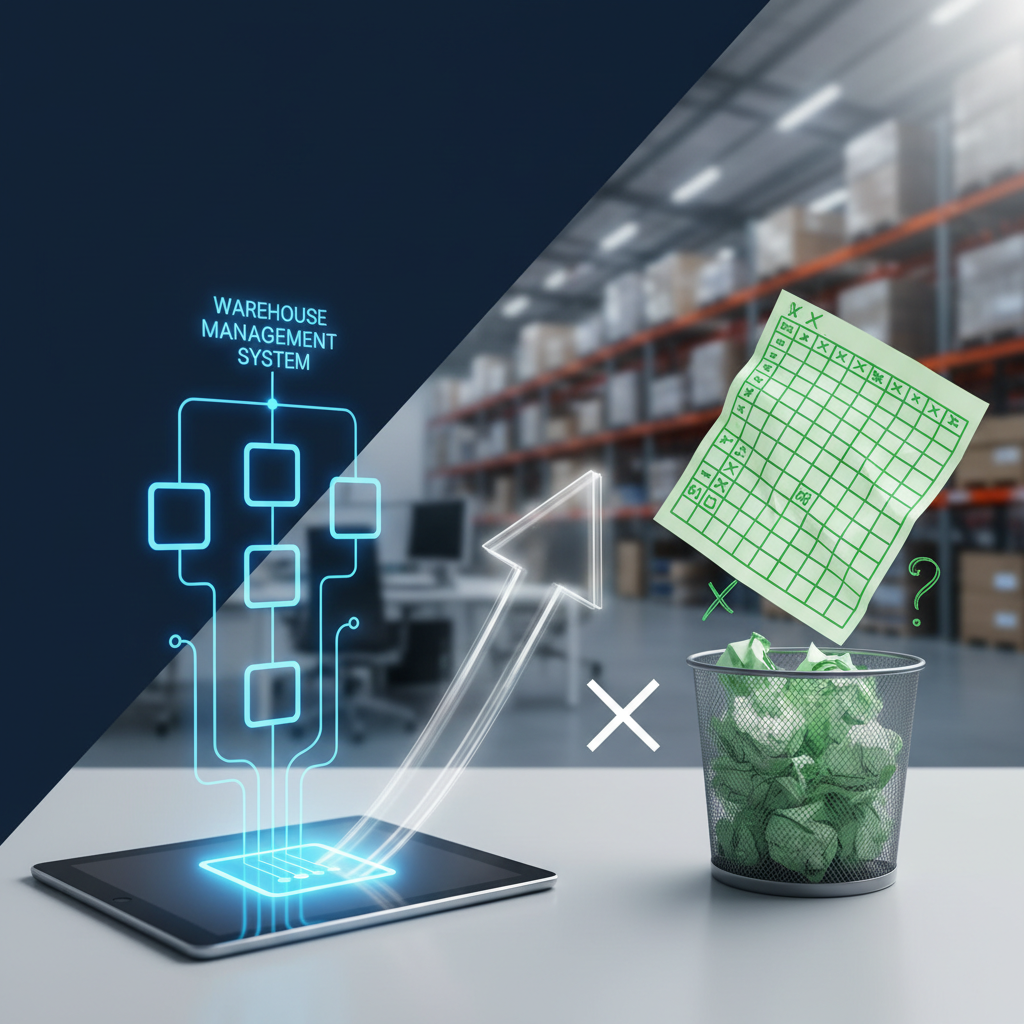
Are you spending more time updating your spreadsheets than addressing actual warehouse issues? There’s a reason why the Excel interface never gets nostalgic about your first order entry: It wasn’t built for your evolving business’s master warehouse data. As you fiddle with an ever-expanding matrix of linked sheets and share files in a frantic juggle to keep everyone’s figures fresh in a spreadsheet today, the competition will have already used their warehouse’s mobile device touchscreen to receive, store, pick, and ship a dozen orders before lunch , with zero chance of a formula error foiling tomorrow’s delivery deadlines. Speaking of which, how would you calculate your warehouse’s accurate labor and time savings, inventory and order accuracy, shipped on time performance, and storage and fulfillment costs with… Excel?
Spreadsheets crack under pressure once daily transactions exceed a few hundred lines. Teams spend hours reconciling counts between shifts, hunting for the latest version of a pick list, or troubleshooting broken links to supplier files. Stock discrepancies appear without warning because two people edited the same row at the same time. Seasonal spikes amplify the chaos: Black Friday order surges or holiday inventory buildups expose every weakness in a manual tracking system. When your team checks email timestamps to figure out which Excel file holds the truth, you have already lost control of your warehouse data.
Another warning sign that you may be outgrowing Excel is the physical constraints of time and space. In the literal sense, Excel doesn’t grant you more of it, and expanding warehouses won’t help you find it. What roughly translates into 17,000 columns by 1 million rows may also sound like more space than you can imagine using, but somehow always seems to max out right around the time you’re somewhere in the middle of not enough. Gigantic files is where performance issues typically rear their sweaty, stressed-out heads, so if you catch yourself sweating bullets every time you update that master worksheet, spare yourself the heartburn.
I bet you don’t have a clue how much phantom stock is bleeding profits. I’m not sure anyone really knows because it’s impossible to quantify the sales lost to customers who walk away after you flub their order. Some will give you a second chance, but many won’t. A system that doesn’t grab the correct on-hand quantity in real-time can kill your reputation in the blink of an eye. It doesn’t end there. Emergency orders eat sky-high freight and productivity costs. Most quantify those, gather phantom inventory data, and you can deduct the overage out of your results.
Excel is a batch processing solution. A WMS tool is designed to be automated. With Excel, multiple locations in a warehouse need to wait until a human conducts a lengthy, time-consuming physical inventory of materials or products, fills out a form or series of forms, transfers those sheet counts over to a computer, then emails the computer sheet to all of the necessary people. End result, inaccurate counts of often-obsolete quantities. A WMS transforms all of that typing time into flicks of a barcode scanner, with the computer database update happening in real-time. Voilà. No universe of inaccurate data files.
Modern warehouse management systems leverage powerful computing resources to direct picking activities in the most efficient manner possible. When a worker uses a random bin location system, the WMS calculates sequenced picking paths based on variables like shared zones, clusters, and wave picking, ensuring each product is collected in the least distance traveled. This optimization minimizes the risk of causing stockouts for other orders in progress by making repeated trips for items close together.
The real power of AI insights may not be its ability to identify optimizations, important though that is. It’s the muscles to do this repetitively and staggeringly fast, ensuring that the warehouse operation is as close to optimal as possible at any given point in time. It’s uniquely qualified to manage this prospect, juggling more variables and computations than are possible for any human. Most of us cannot balance variables on our fingertips, let alone in our heads. It’s beyond spreadsheet software too. It’s pointless to monitor every metric constantly, but algorithms don’t get tired or bored. They don’t overlook a secondary consequence of a change. Ballistic can check in with a huge number of variables as frequently as advised.
One missed keystroke and a 6 becomes a 9. You can’t achieve that kind of speed or accuracy with clipboards and manual counts. You may try to offset potential errors with cycle counting, but your business can probably count inventory faster than your staff can count, assuming time allows for any counting at all in a 24-hour operation. And how do you know which items to count, and when, other than counting everything all the time? If you feel you’ve maxed out on the benefits of manual-count planning because your inventory shifts too quickly to keep up with quantities, that’s another red flag frantically waving above spreadsheets you’re too busy to see.
Customer attrition compounds the financial hit. Shoppers who get the wrong items in the mail or encounter repeated stockouts at your store will quickly take their business elsewhere to a competitor with more reliable fulfillment. Bad news also travels faster than good news, and in these days of instant social media, that can be particularly damaging to your reputation. Customers lost due to poor service will not return until you offer deep discounts or free express shipping. A WMS has validation rules in place at every single scan and will simply not allow a picker to pick the wrong item. Wrong items never leave the dock because your WMS will have already flagged the discrepancy.
Dynamic Traceability Slabs: Managing Batch, Lot, and Expiry Dates Effortlessly Without Macro Crashes
Yet, unlike warehouse transactions, which are typically batched by the thousands, the flow of materials often leads to additions, updates, or deletions to the list of active SKUs. Add acquisitions, migrations, and data syncing, and you get a scenario where inventory databases are constantly changing. Updating a database with tens of thousands of rows while keeping the system running and secure is a real challenge, one you’ve likely assigned to a business analyst full-time.
Making the Leap: A Step-by-Step Transition Strategy from Legacy Workbooks to Automated Warehouse Data
Transitioning from an aging Excel system to a Cloud WMS is not as daunting or costly as you might think. Most of the successful implementations I’ve been involved with began by realizing that old habits die hard. Recognizing that disparate spreadsheets were ingrained into the process, weaning our team off a familiar if dated setup was essential for long-term success. Prior experience garnered from many failed attempts showed us that if the person who designed and managed your Excel system has no say in what replaces it, there is a high chance of failure. Fundamentally, change doesn’t frighten people; it’s that people don’t like being changed. Identifying and fostering your “agent of change” is the first step. They don’t need to be in a leadership position; they just need to be the go-to person who understands the what, where, when, and why of what’s changing. Is too much to claim that Excel itself is synonymous with worry beads and comfort blankets for too many of a generation of warehouse operators?

AMR Leasing vs Buying We’re being asked to do more with less, to be more flexible and quick to adapt,...

ASRS for Automotive Warehouses The automotive industry is no stranger to automation. It’s been making robots and machines do the...

Robotic Palletizer Systems for End-of-Line Automation A robotic palletizer is becoming a part of warehouses and production operations these days....

To provide operational excellence, Armstrong Dematic leads the way towards innovative intralogistics and warehouse automation solutions. Our transformations are based on Industry 4.0 solutions.
Follow us on:


