WCS Implementation Cost Breakdown
WCS Implementation Cost Breakdown Warehouse automation is no longer a luxury reserved for global giants. It's become the lifeline for...



Sure a WMS helps pick and ship the right product for the right order at the right time and at the right temperature. But pharma warehousing is infinitely more complex than many other industries. It’s not just about the movement of products in and out of a building. A pharma warehouse is a living organism, it’s part of the actual drug supply chain. Manufacturing and packaging are often done onsite. Detailed regulatory requirements, the demand for product innovation, and fluctuations in sales volume further complicate the logistics chain. A pharma WMS must be able to cope with all of that. It’s no longer enough to have a list of rules, a schedule and a few barcodes. 2026 is fast approaching and with it comes the serialization of individual products, the need for compliance with DSCSA regulations pertaining to distribution and tracing of pharmaceutical product and for Food and Drug Administration (FDA) reporting on e-pedigrees. Where a WMS would once have had to keep an eye on a few thousand SKUs, it could soon find itself monitoring millions of unique serial numbers. That alone would be enough to overwhelm older WMS systems. What’s more, the Internet of Things will see to it that the warehouse is generating information faster than ever before. The pharma WMS of tomorrow will have almost no choice but to be automated and paperless.
Some of the most stringent audit and compliance regulations globally are imposed on pharmaceutical and medical device manufacturers, distributors, and suppliers. Hazard analysis, process validation, and risk management processes must be conducted frequently and thoroughly enough to satisfy the strict scrutiny of the FDA, EMA, and other regulatory bodies. Your warehouse must provide flawless data and logistics rigor to assemble the entire history of every product passing through it.
With the DSCSA, unit-level traceability has transitioned from a “nice-to-have” to an expected component of any warehouse or production facility. Every product is aggregated under a parent-child relationship within the Pharma WMS, giving it a unique pedigree that’s traceable throughout the product’s lifecycle. This puts manufacturers in a strong position to defend their product if they’re caught up in a recall that isn’t even their fault.
Temperature variations can impact products’ stability. Biologics are especially sensitive. Most pharmaceutical products require storage between 2 to 8 degrees Celsius. Biologics can have even tighter restrictions and do not respond well to slight changes. A WMS automates inventory movement based on demand forecasts or current orders so that no product sits in the wrong storage environment, ever. For unnecessary temperature-controlled space, this can save up to 50% on energy costs.
Managing expiration dates manually? Let’s just say, people are not great at tallying up how many days are left on six different products across three different shelves. WMS, however, is. Pharmaceutical products can easily be wasted due to expiry. But a WMS in a pharma warehouse tracks all those dates and expiry times for you, making sure your employees pick the right ones. Efficiently using stock with the shortest shelf life left and reducing waste.
Pharma Logistics requires complete transparency and traceability. Paper-based systems, homegrown databases, or a mix of software solutions can’t deliver a complete view of every product’s journey. Item-level tracking and genealogy in modern WMS provide a detailed story of every batch or serialized item’s history from receipt to shipping. An interface to Packaging Line Systems (PLS) or other external systems to populate the WMS with production or order information also enhances traceability.
Batch and lot tracking doesn’t end with the last pallet being loaded onto the truck. Rather, the WMS makes a record of which customer received which specific lot or batch of product. The downstream traceability provided by this functionality means you can determine exactly who needs to be notified when a quality issue arises and have notifications delivered within hours. This rings especially true in the case of controlled substances and high-value biologics. You can’t be a batch and a lot off when accountability is part of the recipe. Integration with transportation management systems guarantees that inbound and outbound visibility stretches as far as your goods do.
With warehouse automation, you have to think about the role-based access control that we provide within our software. There are some things that only your maintenance personnel should be able to do in the system, and that’s the same with operating the system, with picking, with packing, with carrying out transactions. We also are able to integrate into systems for security cameras so that you can see and be able to monitor precisely what the automation is doing at any given time.
Modern WMS includes quality control workflows within the application itself. For instance, incoming shipments can be sent directly to designated quarantine areas until lab results verify they conform to your requirements. This precautionary measure blocks the potential for quarantined inventory to be inadvertently picked or shipped in an order, thereby blocking the source of non-conformance. After the quality team releases a lot, the WMS automatically transfers it to active storage and makes the inventory available for Order Management and outbound processes.
Quarantine and Inspection Workflow Automation
When we manually quarantine inventory we must rely on a physical wall and the vigilance of employees to prevent items from being inadvertently used or shipped. Unfortunately, both are prone to failure. An automated Dematic WMS process is far more reliable. The WMS automatically assigns a virtual hold to any newly received inventory requiring quarantine. If it’s not in the WMS database, it can’t be picked. This completely eliminates the possibility of accidental shipment. With an Armstrong Dematic automated solution in place, quality team members are automatically notified upon the arrival of new items and provided with the required samples, further automating the inspection scheduling process. Once the items are cleared, the hold is immediately lifted and the inventory is automatically included in the order fulfillment process. A Dematic WMS practically eliminates unnecessary handling costs and ensures that inventory always flows within your facility as quickly and efficiently as possible.
Controlled Substance Access Management and Serial Numbers
When it comes to patient safety, nothing can be left to chance. Our Warehouse Management Software (WMS) offers the transparency required to track all pharmaceuticals and supplies involved at every step in the supply chain. Perishable drugs and biologicals are held and staged in temperature-controlled cells, refrigerators, and freezers before packing and dispatch. Domestic and international requirements differ, but consistent is the need for full documentation for every step of every transaction for audit purposes. WMS satisfies that requirement.
Safeguarding Public Health with a Compliant Pharma WMS
What makes pharmaceutical warehousing different? The obvious answer is the product. We’re dealing with medications that directly impact human health, even save lives. From APIs and excipients to blister packs and bottles, every item in a pharmaceutical warehouse is a piece of someone’s recovery. Beyond the product, though, there’s the web of regulation that dictates how pharmaceuticals must be stored, tracked, and shipped. Regulations come from every direction, each with the best intentions but often adding layers of complexity (and cost) that can be hard to keep up with. The latest wrinkle: the Drug Supply Chain and Security Act (DSCSA), which requires that every finished prescription product be tracked down to the item level. It’s easy to say that a WMS must be able to handle this. The challenge is to distinguish which WMS actually can.


WCS Implementation Cost Breakdown Warehouse automation is no longer a luxury reserved for global giants. It's become the lifeline for...
Supply Chain Management Software Guide Navigating Modern Supply Chain Challenges Modern supply chains are really complex. Move fast. Many things...
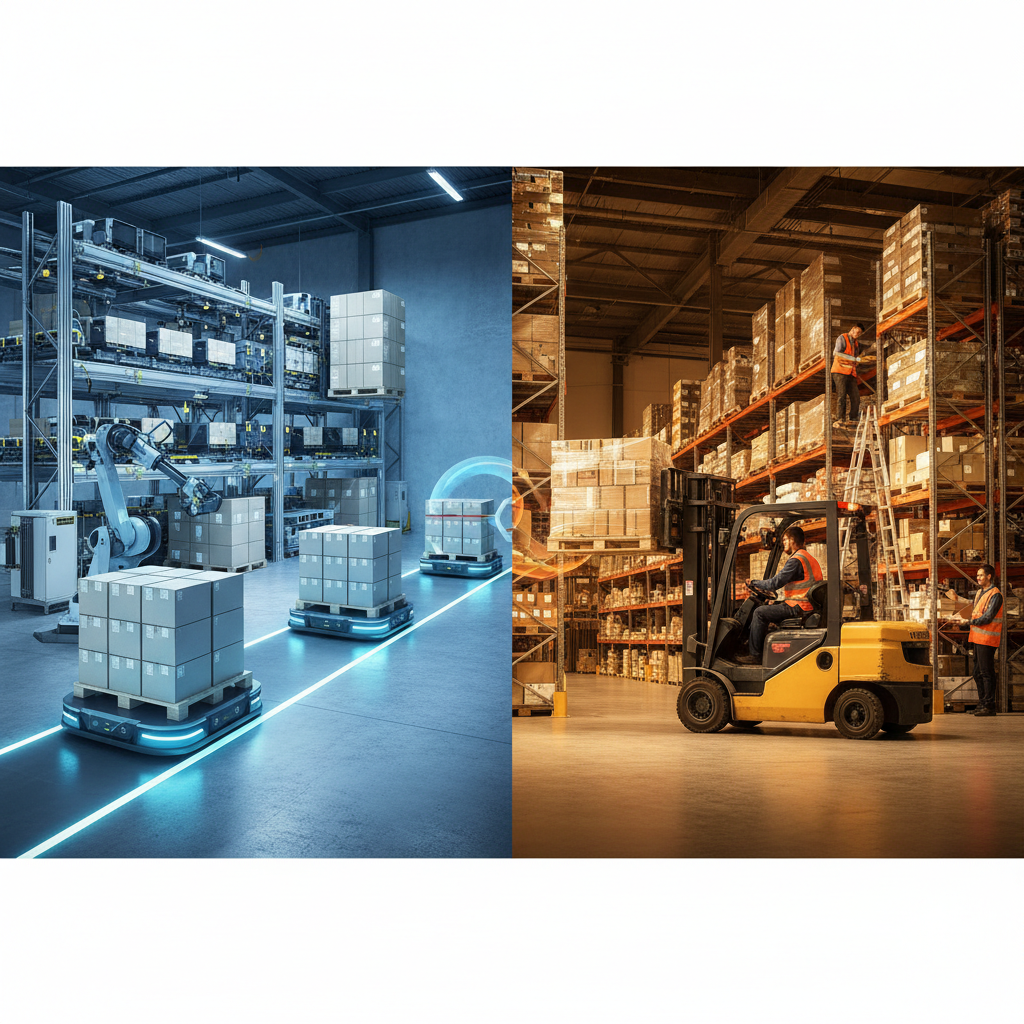
AGV vs Forklift Comparison It's not an easy choice, do you invest WCS (warehouse control software) implementation cost for AGVs,...

To provide operational excellence, Armstrong Dematic leads the way towards innovative intralogistics and warehouse automation solutions. Our transformations are based on Industry 4.0 solutions.
Follow us on:


