ASRS for Ecommerce Fulfillment Centers
ASRS for Ecommerce Fulfillment Centers We often take little notice of just how much work, time, and energy goes into...


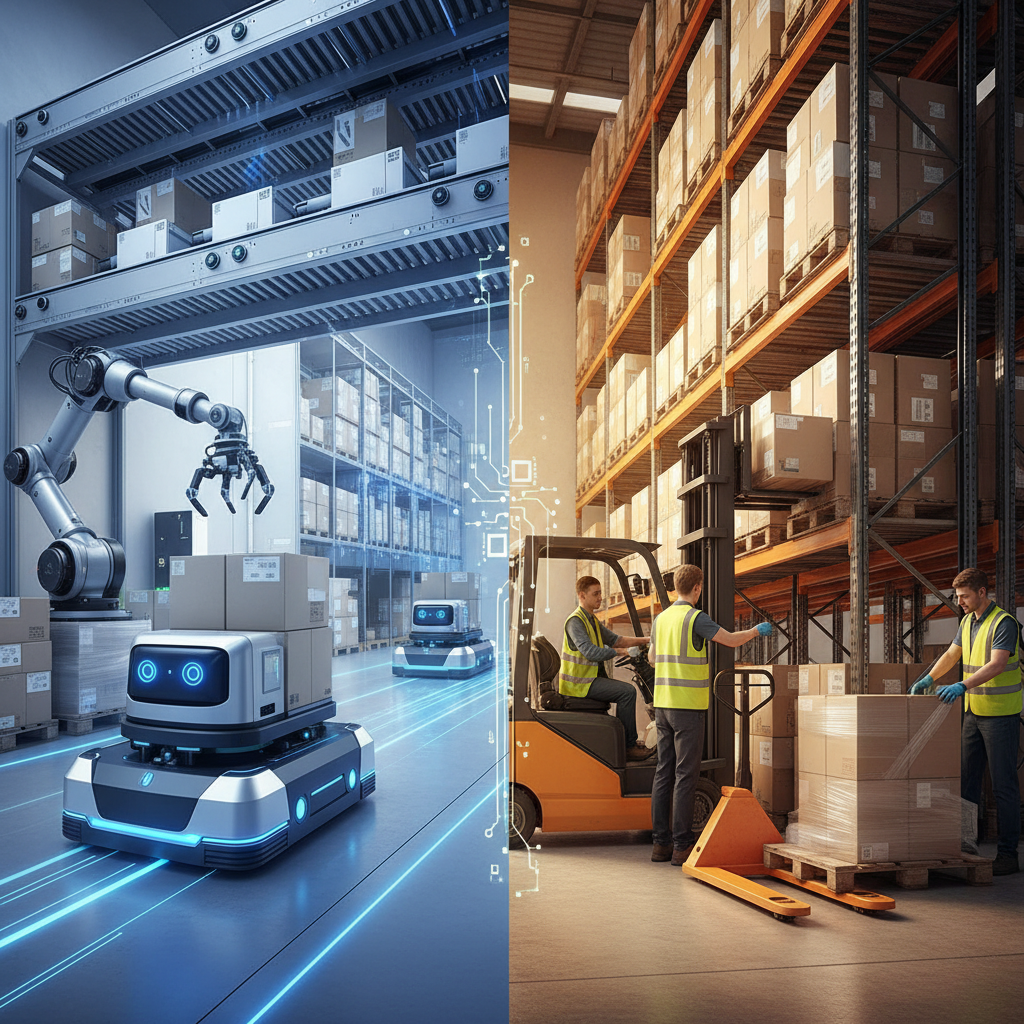
Today we’re discussing a topic that keeps coming up across industries! Manual vs Autonomous Mobile Robot (AMR) order picking: Fruit boxing edition. The ultimate showdown. When the fruit of your labor literally IS fruit (or any other consumer product), how do you know if AMR picking is the better route? What’s wrong with manual labor (picking)? It’s picked apples for centuries (and continues to do so). Are AMRs really that much better? It’s not a small investment after all.
Instead of warehouse staff spending half of their time walking and searching for items, they simply stand still and focus on the cognitive tasks they’re best at. The ease and low cost of training pick-pack workers to use mobile robots is a quantum leap in scalability and lowers the barrier to wider adoption within the supply chain. Should a warehouse’s layout change or another station be needed, a simple reconfiguration of the software makes the robot aware of its new environment. The infrastructure-free nature of AMRs allows them to be deployed or moved within hours rather than days, weeks, or months.
IT’S A SCALE GAME This isn’t an argument for all robotic picking in all DCs. Context’s important. Fleets of AMRs need a lot of volume to be efficient routes. Wheeling a robot down an empty aisle costs as much as wheeling it down one with product. You need to spread the cost over as many units as possible to capture the productivity benefits. It’s why robotic picking will grow from spots in low-velocity omni-channel DCs to the biggest buildings shipping the most units. It’s not about shifting all production to the bots. It’s about identifying the fastest movers in e-fulfillment and adding another powerful robot-human blend to the future of picking technology.
Did you know that manual pickers often spend a whopping 50 to 70 percent of their shift simply walking between pick locations? And in a 200,000-square-foot warehouse, a picker can walk eight to twelve miles daily. Insane, right? Yet all that “exercise” adds up to nothing but wheels spinning in molasses. With goods-to-person AMR solutions, travel time shrinks to almost nil since the robot does all the walking. It’s like having a “smart” forklift fetch the shelf, bin, or pallet and bring it to a stationary picking station where the human picker stands ready. Once the item is scanned and picked, the robot wends its merry way back to the storeroom. Voila! Those empty miles just morphed into more orders filled per hour and lower walking-related labor costs.
Travel reduction also brings safety and worker retention benefits. Why would anyone want a human to walk 10 miles a day when a robot can bring the item to a stationary human? Repetitive walking on concrete floors causes fatigue, joint pain, and higher injury rates. Areas that used to be condensing and social hubs become safer and more pleasant work areas. This includes aisle intersections where the majority of pick-related injuries occur. No humans, no injuries. No flippers, trippers, or sliders needed. MFCA calculates the insurance premium saving for you. Low travel rates open the door for worker-friendly conveniences that improve retention. For example, add those anti-fatigue mats, adjustable tables, and ergonomic tools. renew workers and increase training talent. One customer found worker retention to be as much as 70% better in the robotic DC.
Manual picking with handheld RF scanners gets much less glamorous results, typically around 98 to 99 percent accuracy in well-trained teams. That probably sounds acceptable, until you realize that a 1 percent error rate equals ten wrong items shipped per thousand picks. Those returns, re-ships, and customer complaints add up fast. With AMRs, particularly paired with pick-to-light systems or vision-guided confirmation, accuracy levels soar to 99.5 percent and higher. In these scenarios, the robot brings the correct bin to the picker. A light or screen is positioned right at the item, indicating exactly what needs to be picked up. The picker simply scans a barcode or pushes a button, and, if the wrong item is scanned, the robot won’t move to the next location. The error is detected right there.
Fewer picking errors also lead to happier customers and a better brand, which is increasingly important in the age of social media, where a disgruntled customer can cause real damage. On the other side of the coin, a happy satisfied customer can be your best salesperson. A recent study by Voxware 2019 found that 69% of consumers are unlikely to shop with a retailer in the future after receiving an incorrect order and 72% are unlikely to return after more than two late deliveries. The same study found that 31% of those who received an incorrect order told family and friends, which is probably a low estimate of the damage since unhappy customers are more likely to speak out than happy customers. How many sales this loses is difficult to estimate but certainly much more than the one lost sale. However, many organizations do not count the cost of this lost goodwill in their picking error costs.
You scale manual operations by hiring seasonal workers weeks before peak demand. You then will inevitably spend time recruiting, training, and supervising temporary workers who likely leave after a few weeks. As productivity gradually drops when new workers familiarize themselves with the layout and the tasks, you repeat the cycle annually. AMR fleets scale entirely differently. Most vendors provide you with the option to lease additional units or simply pay for the robots as a service. This allows you to order more robots for Q4 and return them in January. It only takes days to deploy them. The corresponding software is already part of the existing system and will automatically add the new units. They’ll immediately start picking. No onboarding necessary. No payroll taxes. No turnover.
This flexibility is well-suited to businesses with volatile demand. For example, a direct-to-consumer brand might triple its order volume for the holidays. In such a case, leasing ten more AMRs to fulfill those orders over a three-month period is far cheaper than hiring, training, and managing thirty additional temporary pickers. And when the season’s over and demand returns to normal, you simply reduce the size of the fleet. No lay-offs. No severance packages. AMR versus Manual Picking. Gives you that strategic nimbleness. This will be a particularly valuable strategic capability for growing companies in highly competitive markets where the pace of change necessitates quick, frequent shifts in capacity.
Initial Setup Timelines: Software Map Configurations vs. Intensive Employee Training Windows
The Physical and Labor Costs assume that a warehouse with manual picking costs $50 per square foot and requires 30 workers to pick at a rate of 200 lines per labor hour. A robot-picked line is processed every 20, 30 seconds. A manual picker walk time is 50% while a robot’s drive time is only 10, 20%. 100 manual picks are made per labor hour and a robot averages 400 to 450. This fluctuates based on build rules created during mapping. Humans have the edge when picking large, bulky, and slow-moving items with medium-to-high quantity orders. Robots win for small, similar, and fast-moving goods, for upselling by picking single items with each order, or for reducing stockout risk by ordering frequent resupply points.
ROI Analysis: How Long Does It Take for an AMR Fleet to Pay for Itself in E-Commerce Fulfillment?
How soon can we expect a return on our investment in autonomous mobile robots and the other automated technologies we’ve been discussing? The real answer is “it depends.” For warehouse automation generally, the more products you move, the more time employees spend traveling between storage and picking locations. These large operations, with high product counts and tall racks, typically show the best ROI. Narrow-aisle rack-supported systems retrieve deep pallets quickly, with lower construction and energy costs than AS/RS. But if you’re constrained by storage or processing space, don’t want to disrupt existing operations, or can’t commit to a more significant capital investment, manual methods or a few low-tech improvements might still make sense. Neither AMRs nor exoskeletons are cheap. High-volume, high-reach, high-labor markets with tight turnaround times probably make back their automation dollars the fastest. For others, the ways that AMRs and the wager of their tech cousins enrich the work experience, improve ergonomics, and support ramp-ups and break-downs may be just as important as payback times.
The choice between AMR and manual picking is not a simple either/or proposition. In truth, most warehouses and fulfillment centers will operate with a combination of solutions over the next several years. Often based on the 80/20 rule, where 20% of SKUs represent 80% of the volume and where manual processes are used to handle the 80%, while robotics and automation are ideal for managing the 20. Moreover, they will scale based on throughput requirements, capital availability, and the ongoing labor scarcity in most markets.

ASRS for Ecommerce Fulfillment Centers We often take little notice of just how much work, time, and energy goes into...

The goods that come in such large amounts need to be stored at someplace where they can be further identified

In the grand scheme of things, packaging might seem like a minuscule part of the operations. However, your goods need...

To provide operational excellence, Armstrong Dematic leads the way towards innovative intralogistics and warehouse automation solutions. Our transformations are based on Industry 4.0 solutions.
Follow us on:


