How Much Does a Robotic Palletizer Cost?
How Much Does a Robotic Palletizer Cost? Automation has become a high-priority part of business for almost all material handling...


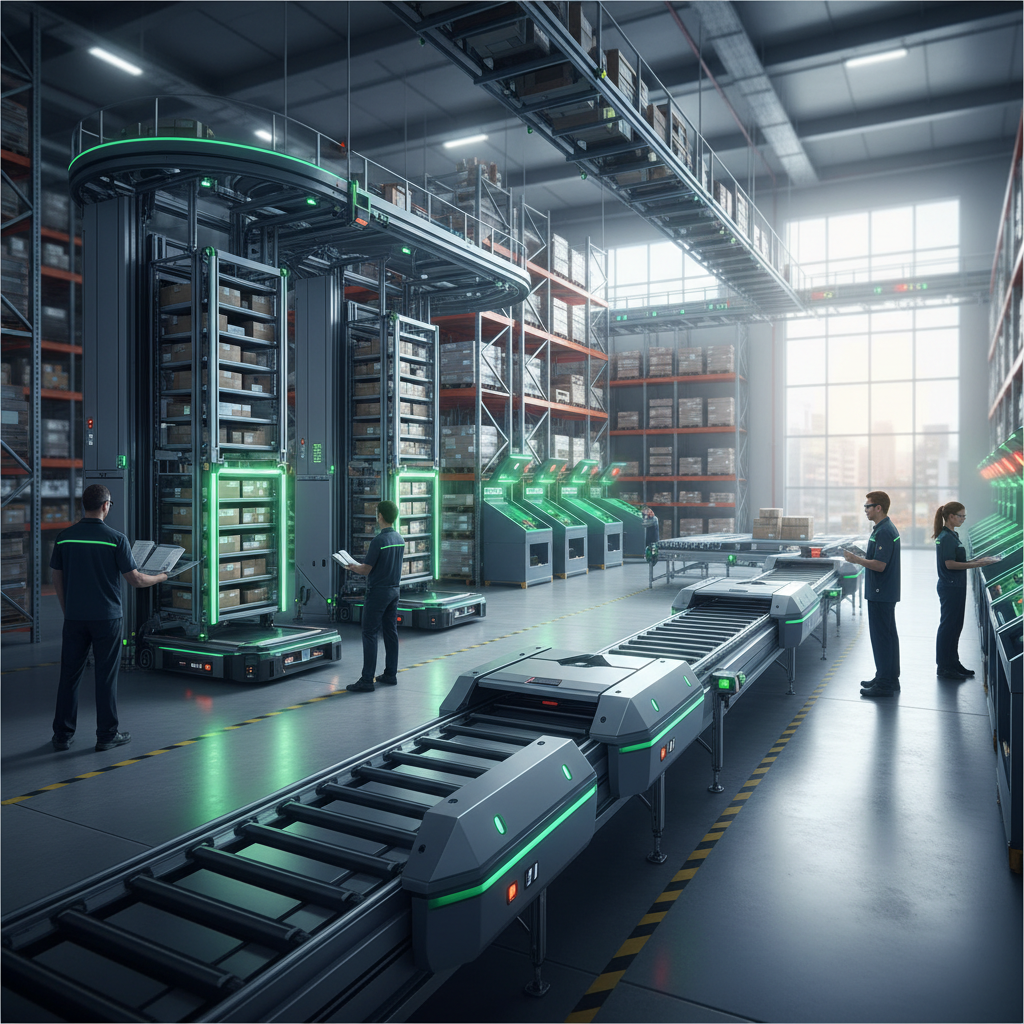
Warehouse automation budgets in 2026 demand precision. But as we’ve all learned, initial capital outlay is the tip of the iceberg. I’ve met operations that budgeted $25 million for automation, then spent well over $40 million to get the system online, and quickly recognized the first-year operating budget wasn’t enough. As they learned, “hidden” expenses tend to emerge after go-live, and for many, the scare got worse last year. Labor rates, property costs, and supply chain disruptions loom larger now.
A loop sorter costs roughly between $500,000 and $2.5 million for a mid-scale installation handling 5,000 to 15,000 parcels per hour. That is a big number. And it grows quickly. Just elevate discharge to a truck route for tote handling. Done. Add loop to the weigh scales or dimensioning tunnel for dynamic cubing, dryers and conveyors to handle, screen, and drop it back into the sorter. Done. Shove parcels at the downstream induction via spiral chutes so you can use shorter tilting crossbelts to handle taller packages. Done. A million skidloaders each. Done.
As e-commerce drives demand for instantaneous ship-to-anywhere fulfillment, loop sorters scale more easily than comparably priced automated guided vehicles and autonomous mobile robots. When the road forward for a segment of the market remains unclear, they offer a less permanent fallback option at low redundancy and higher ROI than traditional tilt tray, cross belt, and other line sorters. What makes the most sense is to replace inefficient put walls, pick modules, and pack stations with high-speed tilt tray and cross-belt loop sorters, automating exceptions and returns handling at the same time. When customer-generated waste increases for environmentally unconscious manufacturers and retailers, these conveyors are a wise ecological choice for internal transport. It’s a buy you’re unlikely to regret, just don’t be blindsided by the true costs. How can all this be boiled down further? Be prepared to spend more than you planned on a machine you probably regret not getting sooner. And be sceptical of lowball quotes to ensure that you’re one of the 91 percent incredibly satisfied with the sorters they selected.
When designing a high-performance, cost-efficient sortation system, subtle technology decisions are crucial. But sorters are not a one-size-fits-all arrangement, and conveyor sortation systems can strain capital and labor budgets. Determining which solution checks the most boxes for your operations requires time and study but can save time and labor in the long run. Streamlining labor tends to be cheaper per hour than expediting conveyor belts, so balance between quality, speed, and cost must be met.
The warehouse shuttle system has a pallet shuttle that transports loads to deeper locations within the rack. Rails embedded in the storage rack define the travel path for the shuttle. Dual (or more) deep operation is achieved because for each rack face there is a track in which the shuttle can move. Once the shuttle is positioned at the desired depth it lifts up (or down) and moves horizontally into the rack to deposit or retrieve a pallet. The shuttle then retracts, lowers, and moves to the recommended bin location. When in motion, the shuttle travels very quickly.
When I walk into a fulfillment center, the first thing I notice is the sheer volume of conveyor and mechanical equipment. When I hear the roar, it’s centrifugal chutes funneling thousands of packages an hour at high speed down a narrow path, feeding dozens or even hundreds of destination sorter outputs. I hear servos kicking to precisely time packages with speed and location before launching them down another chute. I see parcels jockey for position on tight-center take-away conveyors. In the sorter control room, cams whirl as they direct packages with quick left-right flicks and queuing starts if downstream sensors are blocked.
This results in comparable installation and software costs but typically more mounting locations for put-to-light systems, thus a slightly higher cost. For basic put walls, budget an installed cost from $300 to $800 per location. Transporters, whether carts, tilt trays, or crossbelt conveyors, cost $50,000 to $100,000 per each 100 feet of travel length, plus roughly half that amount for controllers, software, and installation. In this instance, pricing doesn’t scale linearly. Four transporters moving 100 feet cost more per foot than a single unit traveling 400 feet. This is because costs related to the charging stations, photoeyes, elevators, controls, and software are the same per foot regardless of travel length.
Well, how much do vertical lift modules cost? A simple $150,000, single-tower unit? Or a more complex, dual-tower $500,000 system that is 40 feet tall and incorporates pick-to-light at the access opening? ” Those are the opening questions in an article on the six things to know before you buy a vertical lift module (VLM). Our VLM cost estimate is based on data from the six North American suppliers of this type of automated storage and retrieval equipment. A VLM in India may cost slightly less given lower prevailing manufacturing and labor rates. Entry-level modules start at about ₹80 lakh ($95,000) with high-capacity units costing up to ₹3 crore ($360,000).
Loop sorters need a lot of ceiling clearance – 12 to 16 feet, and can weigh 150 to 250 pounds per square foot. It’s not even clear that the floors were designed to support automation, so floor-reinforcement costs might add $100,000 to $300,000. Fire codes coming in 2026 will require automatic suppression for high-speed sortation zones, perhaps at a cost of $50,000 to $150,000. Electrical service for three-phase power, backup generators, and uninterruptible power supplies might set you back $75,000 to $200,000. “Customers are often surprised,” says Scott Deutsch, vice president of solution development with integrator Conveyco, when they discover the equipment is just a small portion of the total costs.
Real-Time Carriage Weight Profiler Sensor Deck Recalibration Services
Dynamic weight profiling ensures each carrier knows its payload before diversion. In-line scales and dimensional scanners cost $40,000 to $100,000 per checkpoint. Calibration services run $3,000 to $8,000 per visit, recommended quarterly for high-volume operations. Sensor drift can trigger missorts, and a single percentage-point increase in error rate can cost tens of thousands in reshipments and customer credits. Preventive recalibration contracts bundle quarterly visits, software updates, and spare-sensor pools for $25,000 to $60,000 annually. That expense protects sorter accuracy and keeps your operation inside service-level agreements, making it a non-negotiable line item in any mature automation budget.
Knowing precisely what your costs cover and how the vendor glasses your needs is the foundation of a good business case. Anyone can make a low entry price look attractive. But what’s upfront should always be less important than the total cost of ownership over your expected system lifetime. How do mechanical, electrical and controls, software integration, maintenance, and electrics interface charges all play into your tender evaluation and your long-term budget? What is the real energy consumption profile? What level of support is factored in your agreement for maintenance, spares, and software updates? Who’s on the hook for break-fix emergency, how often will you update?

How Much Does a Robotic Palletizer Cost? Automation has become a high-priority part of business for almost all material handling...
The rapid growth of e-commerce has revolutionized consumer shopping habits, placing an increased emphasis on efficient and expedited order fulfillment....

Every Diwali, as the nation glows brighter, the pulse of Indian commerce quickens. From the sparkle of new smartphones and

To provide operational excellence, Armstrong Dematic leads the way towards innovative intralogistics and warehouse automation solutions. Our transformations are based on Industry 4.0 solutions.
Follow us on:


