WMS Pricing Guide for Growing Warehouses
WMS Pricing Guide for Growing Warehouses Warehouse automation is no longer a luxury reserved for global giants. So many of...


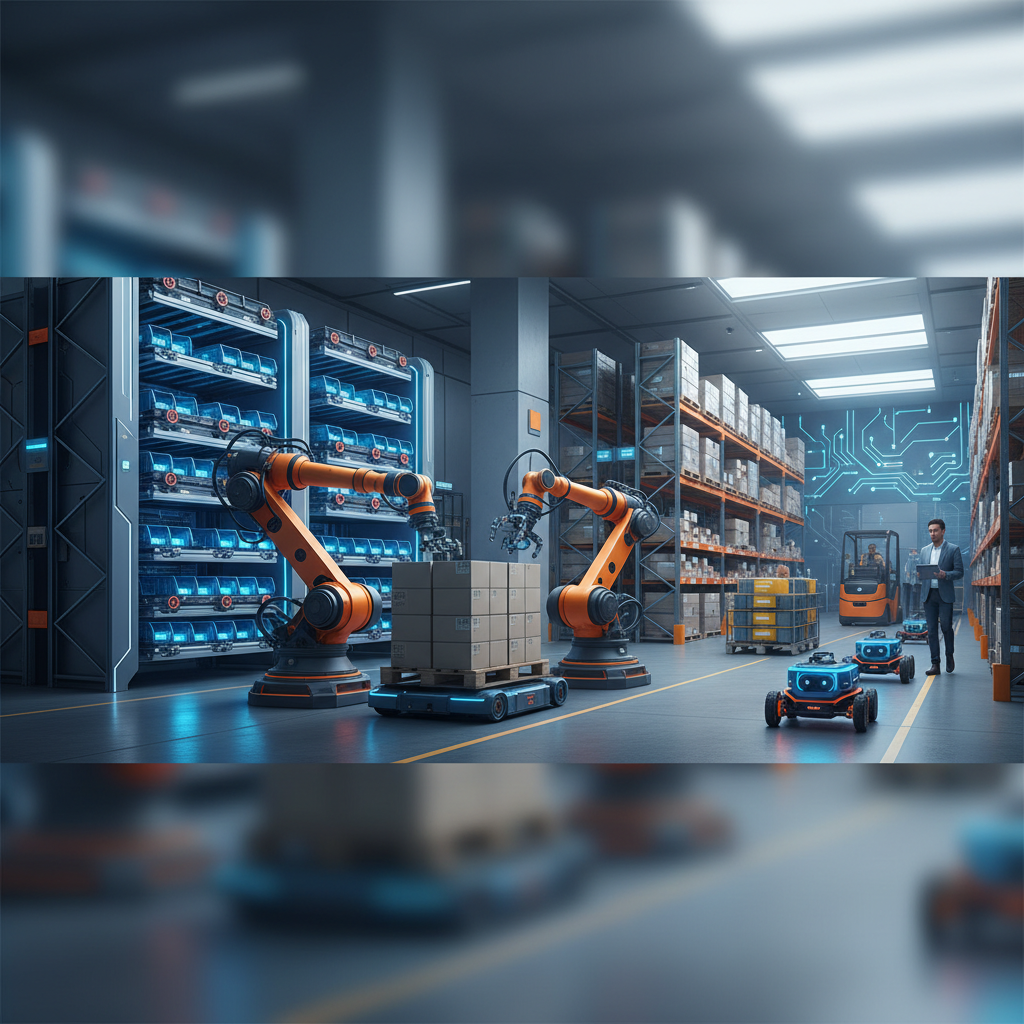
Automation has become a high-priority part of business for almost all material handling managers. But how much budget will you have to set aside for your first , or next , robotic palletizer? The cost varies widely depending on who you ask, but it’s nothing to blink at. Automatic guided vehicles might just drive the actual load, but the teeth are still in the software, control, and automation systems, and that can run from $30,000 to $140,000 per piece of equipment. It’s probably safe to assume that a robotic palletizer will run you at least double that. It’s a big, confusing number with a lot of variation between industries, providers and even end users. But you can crack it. Two numbers: the one-time cost of the system installation, and the five-year cost of ownership.
Robotic palletizer costs in India span a wide spectrum. Entry-level systems start around INR 25 lakh for basic collaborative robots with modest payload capacity. Mid-range industrial units, capable of handling 100 kg payloads at speeds of 10 to 15 cycles per minute, typically land between INR 50 lakh and INR 1.2 crore. High-speed, heavy-duty gantry systems that manage 500 kg loads and integrate seamlessly with conveyor networks can push past INR 2 crore. These figures include the robot arm, controller, and standard programming, but they don’t capture the full story. Installation, commissioning, safety peripherals, and ongoing maintenance can add 20 to 40 percent to the upfront price tag. Exchange rates, import duties, and local integration partners also shift the final invoice, especially for brands sourced from Europe or North America.
The WCS Implementation Cost is another layer. A Warehouse Control System orchestrates the palletizer alongside conveyors, AGVs, and ASRS units. Deploying WCS software, configuring logic for load sequencing, and training operators can run from $15,000 to $75,000, depending on the complexity of your operation. Many warehouses underestimate this line item, then scramble when the robot sits idle because the control layer isn’t ready. Budget for it upfront, and you’ll avoid costly delays.
Articulated robots, the six-axis arms you see in automotive plants, offer flexibility. They twist, reach, and adapt to different pallet patterns without major reconfiguration. Prices for articulated palletizers start lower, around INR 30 lakh for a 50 kg payload unit, but climb quickly as you add reach, speed, and vision systems. Gantry robots, by contrast, move along fixed rails and excel in high-throughput, repetitive tasks. They’re faster and more stable for heavy loads, but they demand more floor space and structural support. A gantry system capable of 20 cases per minute at 100 kg each will cost INR 80 lakh to INR 1.5 crore, including the overhead frame and safety enclosures. The choice hinges on your SKU variety and cycle time targets. If you palletize a dozen different box sizes daily, an articulated arm pays off. If you’re stacking one product at relentless speed, a gantry delivers better ROI.
Grippers may grab all the glory. But it’s the humble, easy-to-overlook end-of-arm tooling that’s doing the grunt work. Between moves, or mid-move with pneumatic assist, end-of-arm tools slide over to lift, place, shift, invert, drill, mill, grind, weigh, or wrap product. They can punch bags and trays. Rotate boxes and cases. Oscillate plastic-wrapped bundles. Reseal pails. Position part boxes and adhesive applicators. Opens, spreads, and fills bags. And scissor, clamp, rotate, or grip like the jaws of death. If you’re sequencing for just-in-time delivery, tool changers are critical. Some joints guarantee results or no pay!
The Relationship Status Between Payload Capacity and Cost; It’s Complicated. What factor influences the cost of a robot more than any other? You might be surprised to hear it’s not the number of axes, whether it’s a SCARA, Delta, or six-axis system, or even the end-of-arm tooling. It’s how much weight the robot can lift and move. “Other than the physical size of the robot, payload capacity is the main driver of cost,” confirms Nishant Dange, director of automation for Motion Controls Robotics Inc. (Motion Controls Robotics is a FANUC Level IV-Certified Servicing Integrator.) Payload determines the gearbox size, motor size, and the robot’s overall mechanics. Indeed, a SCARA with a 1 kg payload will cost less than a SCARA with a 5 kg payload. “Customers don’t always understand this because the robots look similar,” says Dange.
Safety and Integration Extras: Factoring in Safety Fencing, Light Curtains, and Conveyor Links
Safety compliance is non-negotiable and often the largest budgetary offender. Light curtains costs around INR 2 lakh to INR 5 lakh. Safety PLCs are roughly the same. Perimeter fencing, which is extensive for a palletizer because workers are constantly introducing pallets and removing layers, also adds to your bill by about INR 1 lakh to INR 10 lakh. If you have elected for a stationary palletizer, but it’s positioned in a heavily mixed-traffic zone, you will need laser scanners for collision avoidance and e-stop stations on the floor at every entry point. These can be INR 2 lakh to INR 5 lakh per forklift route.
Calculating the Labor ROI: Determining the Payback Period of Eliminating Manual Stacking
A manual palletizing step stool isn’t just expensive; it can’t be an effective solution for the warehouse of the future. It’s an OH&S violation waiting to happen, it can’t keep pace with modern high-speed production lines, and it can’t be redeployed when your manufacturing or distribution footprint shifts in response to evolving market demands. Palletizing robots that come with operator access platforms for pallet tier sheet placement, automatic stretch wrapping systems, and intuitive interfaces for pattern-in-pattern changeover can integrate seamlessly with your existing systems. Leading palletizing robots are compact, capable, and pre-engineered to accept new end effectors for future load or pattern complexity. Your engineers can bolt them onto your line in anything from half an hour to a day, or your systems integrator can do it. Robotic palletizers are only as complicated as you want them to be, from stand-alone systems running software so simple that one operator learned how to use the machine in five minutes, to artificial intelligence that employs machine learning to keep robotic motion in harmony.

WMS Pricing Guide for Growing Warehouses Warehouse automation is no longer a luxury reserved for global giants. So many of...
WMS for Food and Beverage Warehouses Today, high-performing WMS goes far beyond basic inventory tracking. In addition to managing all...
Warehouse Automation Cost in India Explained The costs behind warehouse automation are more than just robots. Handles projections accounted for...

To provide operational excellence, Armstrong Dematic leads the way towards innovative intralogistics and warehouse automation solutions. Our transformations are based on Industry 4.0 solutions.
Follow us on:


