ASRS Case Study: Before and After Results
ASRS Case Study: Before and After Results When the cost of labor began to rise, and the inefficiencies became too...



What are the hard productivity and profitability numbers behind a warehouse automation project that integrates two different robotic systems? We sat down with the distribution center manager of this implementation to do the math. This warehouse automation case study outlines the challenges they faced, the systems they selected, and the results they achieved. With just a few cells of ASRS and two AMRs installed from our partner company, OPEX Corporation, the AMRs deliver cases to pickers for online retailers and takeaways powering dramatic productivity gains. If the results seem impressive, that’s because they are.
I can sense your anxiety levels rise only reading this! I get it. Automated warehouse solutions are an undeniably huge purchase for operations managers with dozens, if not hundreds, of processes and metrics to nearly obsess over. But, in my opinion, we repeatedly overcomplicate this industry transformation. Namely, via preconceptions around what a future-proof ASRS/AMR system should look like. What better time than now to address some of these automation prejudices?
Without automation, we face the same limitations”, admits Diego Menéndez, who managed the European operations of an iconic clothing retailer. Given urban constraints and the high labor cost of manual handling, Menéndez’s distribution center had already reached a maximum capacity, shifting 130,000 cardboard boxes every day through a facility with the footprint of 14 soccer pitches. “I’m not sure anybody really knows how much of the potential capacity is ever used, but we must have been close to it”, he reflects. “Everything is geared to push up the ceiling: more boxes, more merchandise, more stores, but also more errors, more returns, more blockages”.
The company decided to replace manually intensive systems with automation, specifically because they wanted to retain the building rather than construct a new one. Removing the building’s mezzanine wasn’t an option either, so this DC continued operating with the same ceiling height as when it first opened even as the SKU count doubled and order volume increased by 20 percent. A VLM automated storage and retrieval system (ASRS) would keep products out of the aisle and give back that much-needed space. Combining vision-guided AMRs with the VLM enabled the operation to reclaim half the floor space taken up by static shelving and relieve any congestion going forward.
I’m not sure anyone really knows how many warehouses are currently exploring warehouse automation, but it’s got to be a huge number. Thanks to the eCommerce explosion, the need for greater throughput for a growing volume of smaller orders, and the ongoing battle to hire and retain workers, the advantages of warehouse automation have never been more attractive or more accessible. But it’s also true that introducing robots and other forms of warehouse automation can be a scary proposition. The Yamazen team and our automation partners have seen our share of war stories over the years, so we constantly look out for these five qualities and practices among companies we hope to guide to a successful outcome.
Key Performance Metrics
I looked at various KPIs to justify storage automation ROI for the finance team. Direct labor hours per order decreased by 30%, which equated to annual savings that more than covered the debt service on the equipment. Energy costs per unit picked decreased by 12% as the result of the small footprint and the LED lights in the ASRS machine and the efficient battery management of the AMR. Moreover, workers compensation claims related to musculoskeletal injuries decreased by 40%, since operators were no longer required to repeatedly bend, lift, or walk great distances. Receipt and inventory accuracy reached 99.9%. This drastic reduction in write-offs from inventory obsolescence and the corresponding decrease in stockouts justified the costs. In fact, as the business case was put together, we saw all the identified costs be supported as well as some potential future costs be challenged or not funded based on the expectation the automation would drive substantial process discipline improvements.
Lessons Learned
The reality is that most people who get interested in robots begin their education through self-instruction. But, it’s not enough to just make it simpler, as most people don’t even know where to start. Think about it this way: robots rarely fail, people do. But why is this the case? Why is it that here in the 21st century we still see that even our most cutting-edge technology has to be dumbed down to the point of being useless for the average person? It’s not because the technology isn’t smart enough. It’s that there are very few opportunities for the average person to truly learn about technology without going through rigorous academic training. This doesn’t make sense. People are smart, why should they be dependent on smart things?
Conclusion
This case study on warehouse automation proves that a healthy mix of ASRS and AMR technology yields fast payback, measurable productivity increases, and long-term competitive advantage. The payback period for ASRS and payback period for AMR both came in under three years, which flushes out the business case and releases funds for future investments. For those in the automation evaluation phase, the messages are simple: put together a comprehensive vendor checklist, ensure sound ROI calculations, prepare for some systems compatibility issues, and be prepared to invest in change. ItemStack proves that automation isn’t just about machines replacing people. It’s about machines enabling people in ways that create a smarter, faster, more elastic, and more customer-centric enterprise.

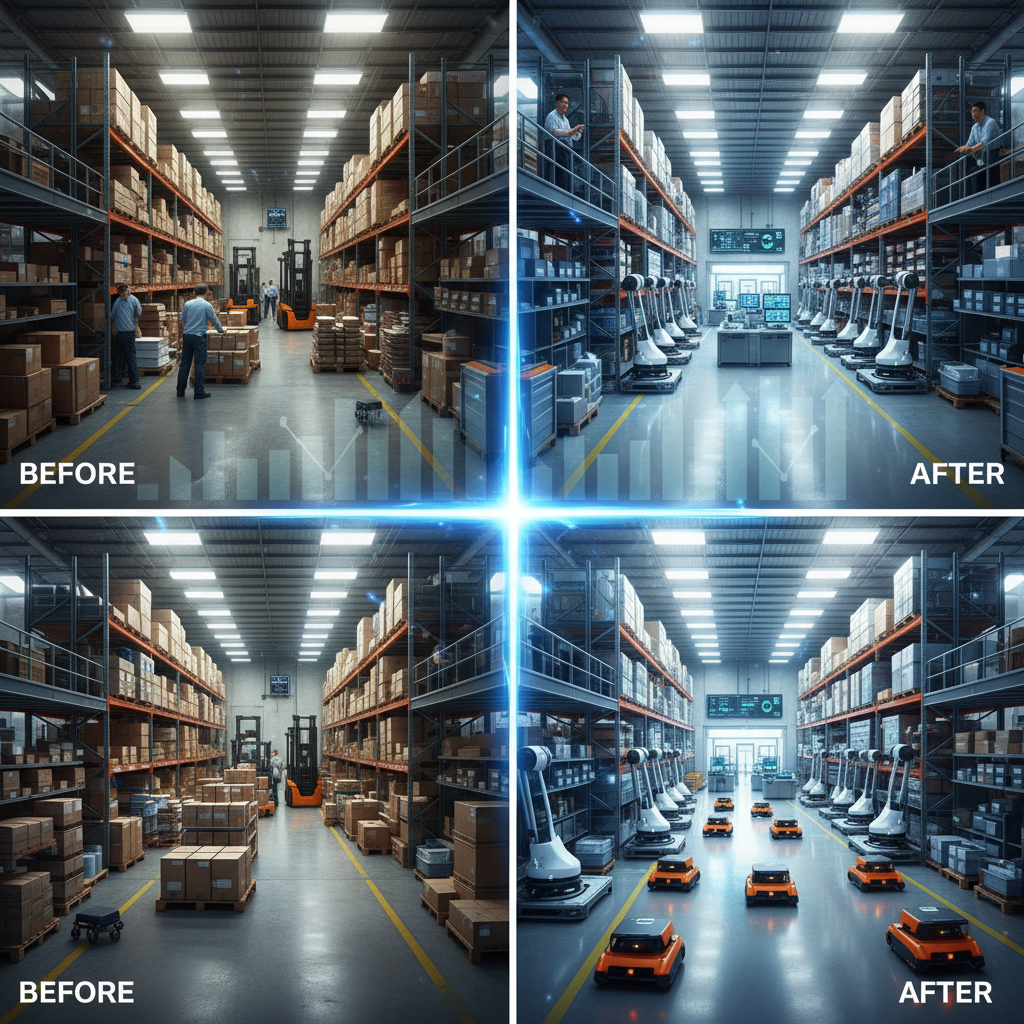
ASRS Case Study: Before and After Results When the cost of labor began to rise, and the inefficiencies became too...
Robotic Palletizer ROI Calculator End-of-line palletizing has long been the bottleneck that slows production, drives up labor costs, and exposes...

AMR Payback Period Guide To start, let’s look at a simplified version of an AMR payback period calculation. The actual...

To provide operational excellence, Armstrong Dematic leads the way towards innovative intralogistics and warehouse automation solutions. Our transformations are based on Industry 4.0 solutions.
Follow us on:


