AGV Price in India: What to Expect
AGV Price in India: What to Expect Warehouses in India are racing to automate, and at the heart of this...


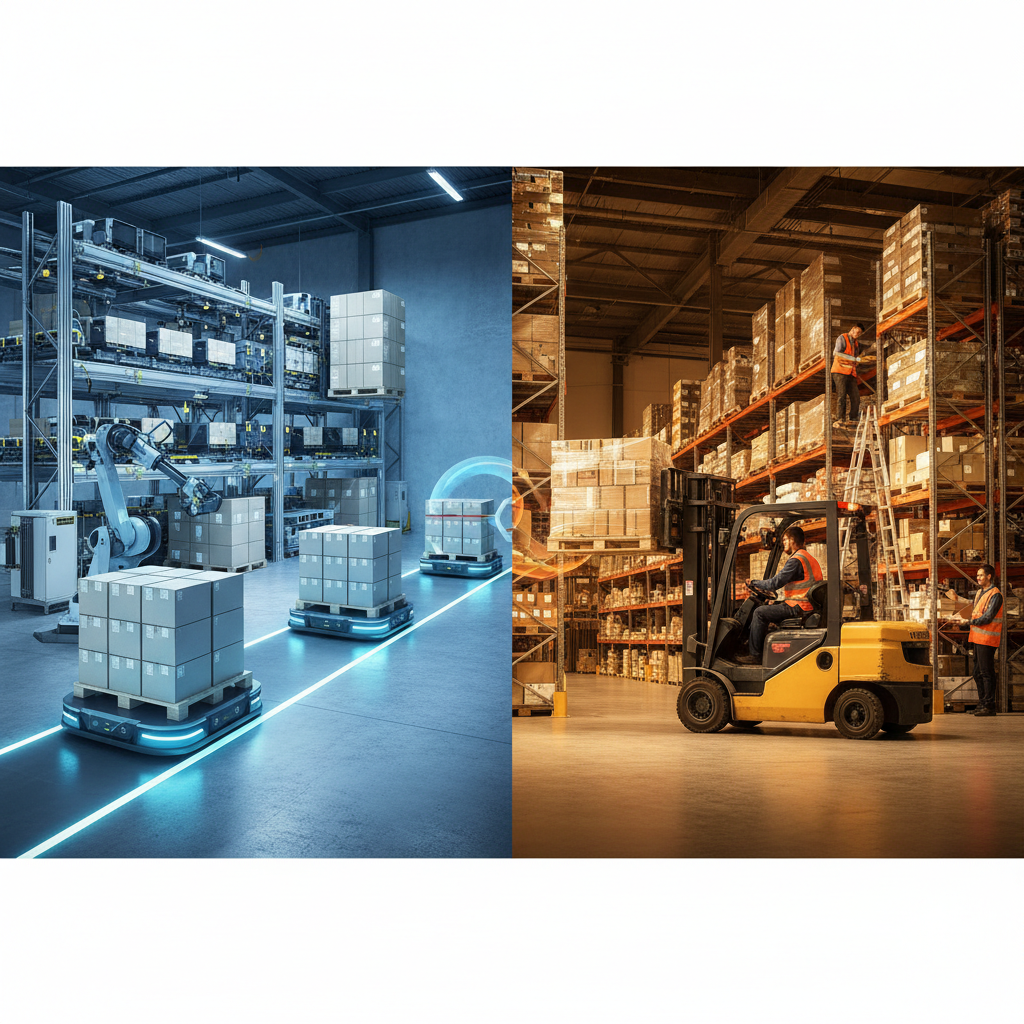
It’s not an easy choice, do you invest WCS (warehouse control software) implementation cost for AGVs, maintenance, and battery storage or pay multi-shift labor to virtually work as forklifts while moving pallets in and out of high-rise racking. A similar conundrum comes up when considering ASRS (automatic storage and retrieval system) vs Traditional Racking for full pallet storage and AMR (autonomous mobile robots) vs Manual Picking for case picking. The potential benefits of automation are well-known; the real trick is knowing which investment will pay off the most.
How do you navigate these options? Both Forklifts and AGVs excel at different tasks. A forklift carries heavy loads, delivers them across a factory floor, and neatly stacks them in a 3-meter-high rack. It’s a bit like a world-class conductor who also has to haul instruments on and off the tour bus. The autonomous mobile robot, or AMR for short, ditches the conductor gig. Instead, it specializes in just one portion of the factory-floor symphony. The AMR becomes, say, the resident harpist, performing its light, repetitive, and straightforward tasks with precision and tireless devotion. Which would you rather have in your warehouse, the multitalented conductor or the precision harpist?
How do you decide what role people and robots should each play in your operations? Given the proliferation of smart machines that are more flexible, affordable, and easier to integrate than earlier generations, these decisions are no longer clear cut. At the same time, labor is in increasingly short supply, and companies strive to be employers of choice for the best talent. How do you determine the optimal balance between mechanization and human effort and what attributes should the ideal worker of the future have?
Initial Capital Investment: Upfront Acquisition Cost of Driverless AGVs vs. Standalone Industrial Forklifts
A new sit-down forklift might cost you $25,000 to $45,000 barring complications, with costs dependent on the capacity of the lift and whether it’s powered by propane, diesel, or a traditional lead-acid battery. A simple wheeled AGV, on the other hand, is unlikely to generate a quote below $50,000 per unit, and the price for a beefy model that can tote 10,000 pounds or more, climb ramps, or be outfitted with attachments like paper roll clamps, can easily exceed $150,000.
And don’t overlook the expense of designing your facility to accommodate robotic palletizers and AGVs, including wider aisles and areas dedicated to robotic mobility equipment. Whether AGVs and robotic palletizing systems drive ROI comes down to your capacity needs and how much you have budgeted for direct labor. It’s worth noting that underlying technology for each is advancing rapidly. For example, 3D vision and machine-learning software have made robotic palletizing nearly as fast at handling variable case sizes as other methods.
Writers are the largest financial burden in forklift handling. Regarding two or three shifts, if you have a $40,000- a-year (with benefits) driver, faced with a 24/7 question, you need five FTEs a driver for any hour trucking which would cover driver’s hours, training, breaks, and vacations. This equates to two hundred thousand dollars per annum. An AGV removes your need to pay that driver but adds in the constraints of a maintenance contract, pushy software houses licensing software, and our beloved battery. A maintenance contract for an AGV would roughly cost you 10 to 15% of the purchase price of the vehicle per annum.
Battery life is also a consideration. The lithium-ion packs in AGVs typically last four to six years and cost $15,000 to $30,000 to replace; lead-acid or lithium batteries in forklifts follow the same replacement schedule. But no matter how much you pay for replacement batteries, the long-term savings we’ve been talking about materialize only when the AGVs are running constantly, night and day. In lower-throughput facilities, the flexibility of forklifts makes them worth the labor premium, especially if you already have drivers on staff handling other tasks and can easily pull them from those duties for maintenance and refueling or if you can use automated solutions to reduce the number of drivers needed for manual lift trucks.
That’s one way to address the risks posed by forklifts, those small but powerful workhorses found in virtually every climate-controlled manufacturing and warehousing space in America. But is it the best way? I’m not sure anyone really knows, but I might argue it is. The fully autonomous guided vehicle can do anything the forklift can in terms of moving goods. It doesn’t get tired, call in sick, or flee to another employer for 10 cents more an hour. And it won’t back over your foot, either.
Yet, this seemingly failsafe approach to autonomous warehouse navigation is not without risk. Bad programming, wrong measurements, or untrained operators can result in “no-go” zones that trap employees in aisles as AGVs approach. Worse, passing an AGV in a narrow aisle might feel safe, leading pedestrians to assume the machine will detect and stop for them. Too often, people can get injured when an AGV reads an intersection as empty and a pedestrian assumes the AGV will yield.
Facility Layout Adjustments: Fixed Infrastructure Requirements for AGVs vs. Flawless Forklift Flexibility
But is the choice always this clear-cut? Dynamic aisles in a racking system less than 60 inches wide are fine for AGVs. Forklifts need a lot more space to maneuver. Shopping around for the perfect automation system isn’t new. Baggage handling, cash-to-cash, and palletizing/depalletizing systems have been selectively automated for years. Item picking’s one of the few material handling areas that isn’t easily automated, and that’s changing. It’s first in the queue for a lot of reasons. It’s hard to find people who want to do it and even harder to keep them.
The ASRS vs Traditional Racking debate mirrors this trade-off. Automated storage and retrieval systems (ASRS) maximize cube utilization and speed but lock you into fixed aisle widths and rack heights. Traditional selective racking lets you swap beam levels and add or remove rows with minimal cost. Similarly, AMR vs Manual Picking hinges on order variability. Autonomous mobile robots (AMRs) excel in e-commerce fulfillment with consistent pick patterns, while manual pickers handle custom kitting and fragile items more gracefully.
Total Cost of Ownership (TCO): A 5-Year Financial Comparison in Busy Distribution Hubs
Let me pose a rhetorical question: is a single forklift running two shifts really a fair comparison? If you analyze an AGV/ASRS system where an AGV serves multiple ASRSes on multiple shifts, the numbers are eye-popping. Far fewer workers and vehicles are required because the fully automated systems keep moving. Then there’s the multiplier effect from the myriad additional areas where people on foot and forklifts collide, with costs that include everything from the workers’ comp to damaged product. It’s like one of those country station wagons that hold two dozen clowns having a single-purpose vehicle like a forklift is the least efficient way to go.
Change the size of the operation and you change the answer. It’s no surprise that large operations quickly recoup the WCS investment and go on to save millions over forklift fleets. To start, compare vehicles, not total WCS. A healthily optimized WCS investment is typically 7, 10% of total vehicle cost. For example, a $25,000 AGV edges WCS costs to the $40 , $55k range. Apply the 7, 10% rule and WCS isn’t much more than a rounding error. However, WCS costs $13,000 over five years, forklift labor $600,000. Move from 10 to 20 vehicles, WCS costs remain virtually unchanged but the savings model doubles.
It’s hard to predict which solution will be more cost-effective in the long term as it largely depends on your specific circumstances. Are you aiming for growth and looking to scale up your operation quickly? Or are you operating in a relatively stable market, with just enough space and equipment to satisfy demand? What’s your input in terms of labor availability and how sustainable is that over time? These are all things you need to consider before taking the leap into any investment, whether that’s for a new forklift or for AGVs.

AGV Price in India: What to Expect Warehouses in India are racing to automate, and at the heart of this...
ASRS for Automotive Warehouses The automotive industry is no stranger to automation. It’s been making robots and machines do the...
In the present day, the corporate realm is characterized by its rapid pace, prompting enterprises, regardless of their size, to...

To provide operational excellence, Armstrong Dematic leads the way towards innovative intralogistics and warehouse automation solutions. Our transformations are based on Industry 4.0 solutions.
Follow us on:


