The Growth of Micro Fulfillment in E-commerce: What You Need to Know
The rapid growth of e-commerce has revolutionized consumer shopping habits, placing an increased emphasis on efficient and expedited order fulfillment....


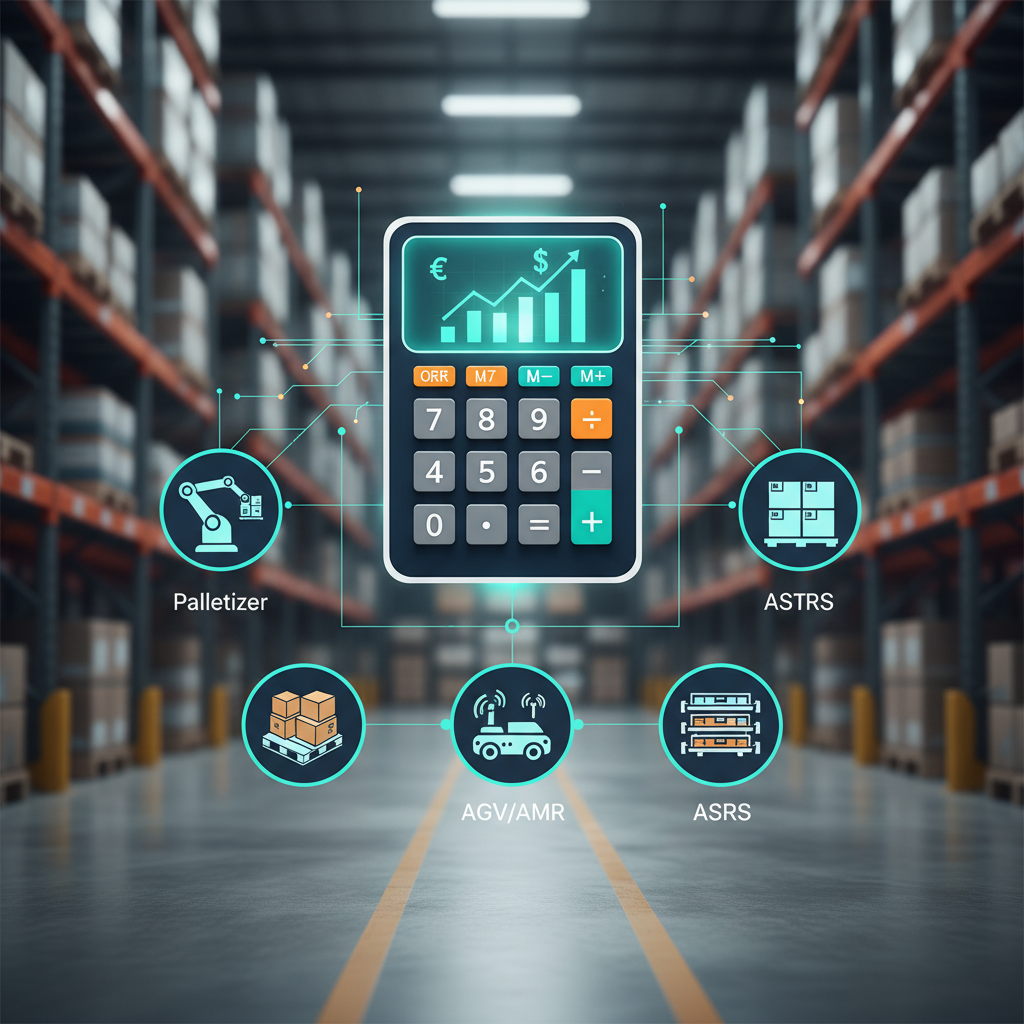
Warehouse automation no longer remains a boardroom dream. It’s a shop-floor reality for material handling in factories across North America, Europe, and Asia, where autonomous guided vehicles (AGVs) cut labor costs, raise throughput, and reduce accidents. However, the transition from people-powered logistics to self-directed fleets demands careful financial planning. An AGV ROI calculator takes the guesswork out of the numbers, providing you with the information needed to justify capital expenditures and pinpoint when payback will start. This article explains what you need to enter into an AGV ROI tool. Next, we walk through the logic and formulas that the calculator uses, comparing AGV costs and benefits with those for traditional equipment. Finally, we look at how battery and electrical infrastructure decisions impact a long-term AGV payback.
AGV’s perform best in operations with predictable and repetitive material movements. While knowing your SKU count is valuable for sizing an AGV fleet, many early adopters started with a handful of well-established metrics. If you stack all your loads in a corner at the beginning of a shift, measure that distance. Count the number of pieces in a typical load and multiply it by the average load weight. Finally, estimate how much time employees spend waiting on forklifts to arrive.
When it comes to automation, you should ask for quotes in as much detail as possible from your warehouse software provider or AGV vendor. What is the unit price per vehicle, the estimated cost of necessary navigation infrastructure (whether that’s sensors, reflectors, or new-floor-markers)? How much are the fleet management software licenses and what ‘integration cost’ is estimated to connect your AGVs with the design and operation of your warehouse management system? Next, are there potential building costs to consider in making the purchase of AGVs? Labor and project management overhead for installation likely will not be included, and those may vary as a percent of the overall automation hardware cost. Many WMS vendor selection processes will bundle increasingly competitive automation hardware quotes with your software as part of a subscription or service lease model. Be certain they have clearly communicated whether ongoing support is included or billable, as a percentage of initial automation hardware costs or otherwise. A lot of preconstruction type work may be necessary to install additional sections of track within your existing rack and aisle configuration. Make sure that concept is included in the quote as bracketing or chargeable with a little “c.”
Labor arbitrage is the primary motivation for most AGV purchases, particularly for forklift-AGVs and unit-load-AGVs. From a total cost-of-ownership perspective, labor is often one of the top expenses in materials handling operations. In a manufacturing environment, for example, a single forklift operator in a developed market turns over between forty thousand and sixty thousand dollars annually when all benefits and insurance are included. Multiply that by three shifts, and a single vehicle route costs upward of one hundred fifty thousand dollars per year in operator wages. Most unit-load-CART-AGVs and forklift-AGVs can be configured to operate at least twice that long on a full battery charge.
Traditional material handling equipment also masks variable costs that AGVs automatically get rid of. Forklift damage to racking, pallets, and inventory averages several thousand dollars per vehicle each year. Operator turnover prompts recurring recruitment and training costs, while absenteeism necessitates overtime premiums or temporary staffing. AGVs follow the same route with millimeter accuracy, minimalizing product damage, and removing the staffing fluctuation linked to manual operations. When you incorporate these soft savings into your warehouse automation ROI worksheet, the financial gulf between human-driven and autonomous fleets widens even more. Of course, the AGV comes with new expenses including fleet management software and occasional sensor recalibration, but these are manageable and still way below the wage inflation and turnover cycle associated with manual labor.
Workplace injuries are expensive in every respect. There are direct costs: medical claims, posting of the incident, possible worker’s compensation claims as a result, and a likely increase in your workers’ compensation premiums. Legal claims and settlements, productivity loss, regulatory fines, and reputational harm all drive up indirect costs. We might not be able to do anything about a hurt worker or a damaged rack after the fact. However, we can keep AGVs from running into pedestrians or into the racking in the first place.
Damaged goods and equipment can create more problems than just the cost of replacement or repair. Products that are not compromised but are out of spec due to mishandling must be written off as a loss, a direct hit to profitability. Additionally, sub-par goods may be shipped accidentally, only to be returned by the customer down the road, inflating your reverse logistics bill while eroding your brand and reputation. A robot effectively removes the risk of damaging goods by impacting them and does not tire over the course of a shift, losing focus and making mistakes due to fatigue. Beyond good and equipment safety, pushing the fleshy operator out of the equation improves overall facility worker safety as well.
Laser-guided vehicles are the most expensive to install yet offer the greatest routing flexibility, prompting some vendors to tout “virtual line” systems that project guidance patterns from the vehicle itself. Finally, vision-based guidance extracts landmarks from the environment, requiring no infrastructure modifications or added materials beyond a camera and image-analysis software. Still in the prototype stage, vision guidance will be the cheapest to install and perhaps the most adaptable.
Include these costs in your project budget. Magnetic tape is two to five dollars per linear foot to install. A 500-foot loop therefore costs one to twenty-five hundred dollars to patch in plus installation expenses. QR and reflective-target guiding systems will roughly double these costs but provide quicker and less expensive route adjustments. Aisles often need to be widened to negotiate AGV traffic, and sometimes the aisle addition or full-alley pathways for vehicle travel must be factored in. Aisle additions can be surprisingly expensive, especially for operations where space is tight. There is no monthly lease for the right of way that an AGV system uses as there is for the fixed real estate demanded by robots and human pickers. But don’t forget that ongoing aisleway costs cover more than just the lease cost. Two maintenance repair operations management (MROM) jobs per month could be tied to AGV bump and scrape damages if you don’t get aisle widths correct.
Battery Ecosystem Options: How Opportunity Fast-Charging Affects Long-Term System Downtime and TCO
Imagine buying a new car and having to replace it after four years, then do it again two years later. A lithium-powered AGV usually outlasts two lead-acid models. In addition, while a spent lead-acid battery’s still one-third charge might support grid stabilization efforts, disposing of it costs almost as much as producing a new one. Conversely, a lithium-ion pack retains eighty percent of capacity when gracefully retired three or four times longer than its lead-acid counterpart. Should we need to ease the stress on raw material supply chains, lithium battery recyclables are more valuable too.


The rapid growth of e-commerce has revolutionized consumer shopping habits, placing an increased emphasis on efficient and expedited order fulfillment....
WMS for Ecommerce Fulfillment Warehouse Management Systems (WMS) have three basic components. Firstly, they tell the hardware where to move...
ASRS Payback Period Calculator Guide Warehouse automation fits most comfortably under the broad umbrella of technologies and systems that enhance...

To provide operational excellence, Armstrong Dematic leads the way towards innovative intralogistics and warehouse automation solutions. Our transformations are based on Industry 4.0 solutions.
Follow us on:


