ASRS Implementation Cost Guide
ASRS Implementation Cost Guide Upgrade your warehouse in 2026 and you won’t just pay more for real estate and labor...


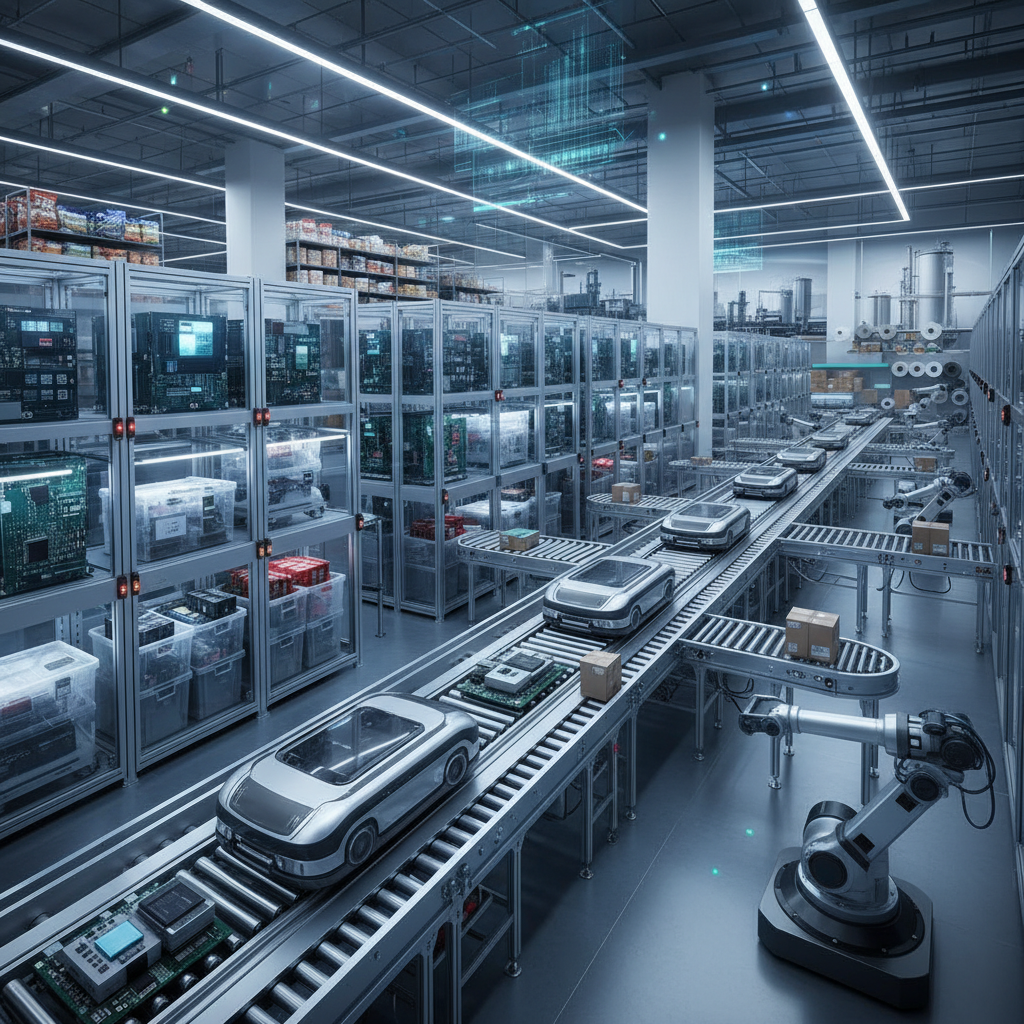
I would bet there’s an electric or electronic device within arm’s length of you right now. For example, a smartphone. It’s amazing how gadgets keep getting smaller, right? But remember the phrase “good things come in small packages”? That’s true of electronic components, too. Why? Because the tinier resistors, capacitors, and diodes are, the faster and more energy-efficient all your electronics can be. Sounds like a win-win. But it also sounds like you’d need a special warehouse to store chips smaller than 2mm, reels thinner than paper, and product lifecycles shorter than the time you keep your phone. Oh, and it has to be dust-free and well-lit too. Lucky for you, someone’s already invented that warehouse. And the same technology will protect your electronics from tiny disruptions along the whole supply chain.
This goes beyond lost leaders or bargain-bin stock. The electronics industry burns through a preposterous amount of money every year due to waste in its supply chain. It’s fundamental to understand that electronics become obsolete the moment they’re manufactured. It’s the components, tiny parts that are so easily lost, that add up to more than $15 billion in overstock every year. This lost revenue isn’t simply chump change; these are parts that are hugely expensive to produce. Many cost thousands of dollars per square inch to manufacture, yet the electronics industry operates on some of the slimmest margins in manufacturing. For many electronic component manufacturers, their warehouse inventory is worth roughly the same as two weeks’ worth of sales.
When we talk about Electronics Inventory Storage, we’re not just talking about shelving systems where components sit awaiting shipment. We’re focused on an end-to-end view of electronic component handling through your facility until the precise moment components are assembled into a product. For electronics products, parts may arrive together to your plant, kitted and sequenced for the line, or may arrive to your facility as individual reels or tubes, their barcodes directly applicable for use in your lean manufacturing practices. Laptops and smartphones are shipped every 17 seconds, each one being a different slightly variant end-product from the next. Part changes can happen every day as the factory retools for new production runs. Small, precise parts change every few hours and must arrive at the line with a frictionless, unalterable part history.
What challenges are electronics manufacturers and distributors facing that are different from other industries? For many products, lifecycle can be measured in quarters. If a component is ordered today, it may already have a newer revision before it’s even left the shipping dock. This is extraordinarily difficult to manage using manual or static storage systems. People can’t track obsolescence dates and automatically pick older stock first, but ASRS can. Similarly difficult is the service requirement for legacy products many years post discontinuation. Someone must be able to locate the half dozen spares that were manufactured and placed in deep archive every time an order comes in. For operations without ASRS, this could take hours of manual labor.
Security is yet another area in which Electronics warehousing differs from something like Chemical Storage Automation or Textile Warehouse Automation. A pallet of fabric has value but a tray of microprocessors worth $500,000 looks exactly the same as one worth $50. ASRS removes that exposure entirely, via access controls that require biometric authentication and create an audit trail for every access. Armstrong Dematic Ltd systems not only log what was accessed but who requested it, and for which work order, and when.
The obvious place to begin is with physical space. ASRS for Electronics Industry systems, that harnessing hoists, cranes, and the entire vertical cube to minimize their footprint, take full advantage of every available inch. They hold two, four, eight times the inventory that a traditional operation can, enabling an 85% utilization rate. Compare those numbers to the 40% common in manual warehouses. Chances are good the figures represent “doubling your capacity within the same four walls,” a mantra that’s music to the ears of any distributor competing in today’s landlocked real estate market. But beyond those obvious benefits of greater height and depth, there are more subtle but no less transformative advantages these warehouse systems offer. The first is in increased picking efficiency. High-velocity SKUs remain in the ergonomic “golden zone,” no more than chest-to-knee height on the worker. Slow movers, however, get automatically stashed up above. Guess where inventory “leads” are spent. Expect to tap those savings quickly. They work in perfect conjunction with another way these warehouse systems will change your warehouse: Eliminating people space. That’s the second key advantage. Everything isn’t just a little denser; your operation is a little less populated. This comes inherently with automation. Less labor, less employee break space, and locker room, less supervisor office space, less training room, less conference space. Less.
Certainly, achieving the same results manually would require meticulous manual counts or multiple layers of human quality control, each slowing operations to a pace that largely negates the labor cost advantage. Unless your team is already working that slowly, in which case you’re already absorbing unnecessary expense through salaries and square footage. Plus, humans do that monotonous work much less reliably than machines. ASRS can combine fast, dexterous automated order fulfillment with ultra-precise checks and controls to ensure no fraction of a percent of waste.
Why do electronic components pose electrostatic discharge (ESD) risks? Some package types and materials generate static. Devices may also discharge if they become electrically unbalanced. Insulation materials and high-speed component miniaturization exacerbate these risks. Once discharged, a component fails testing; however, partial degradation may reduce useful life. Organizations typically define and enforce compliance with standards such as the 61340 ESD series. Electrocomponents often ship in protective packaging to safeguard against ESDs; storage and picking equipment require similar protection if preventable on-ground discharges are to be avoided. ESDs likely cost the electronics industry billions each year.
Mini-load ASRS systems store powered rollers, belt conveyors, or other conveyor types, usually integrated into a warehouse or distribution center to optimize working inside a relatively small footprint. Building up instead of out, the high-density concept significantly reduces the distribution center size by limiting employees and material handling equipment needed to less than a few aisles width. Each pallet rack location doubles or triples since only sufficient access between product shelves is left for the automated mini-load crane to operate. This efficiency can boost electronics distribution center performance, supporting retail distribution, or e-commerce order fulfillment.
Automated Vertical Carousels for Swift Micro-Part Retrieval
Vertical carousels are a fantastic, space-saving solution for warehouses storing lots of small items, but what about locations with fewer, larger parts, or spaces too small, without the headroom needed for a carousel to rotate? Floormount Linear Shuttles deliver the same goods-to-person principle and operator productivity improvements as carousels, while working within a compact two-aisle layout and returning 50, 60% of space to the building footprint compared with static shelving. This stacker-crane system is ideal for compacting bulky or heavy loads of electronic components such as transformers and capacitors, and it’s especially effective in the dead space created when racking can’t run right up to a low roof. While part consolidation isn’t as complete as with other solutions, the ease of implementation, scalability, and picking speed can make Linear Shuttles an attractive option for smaller businesses or cleanrooms.
Would any organization doubt it should and could optimize these flow challenges? It’s not only about the docking stations. This is ecosystem-wide. Every manufacturer on the floor you can think of is either already using ASRS or seriously considering adoption. These create-link-as-you-go systems have also spread from distribution centers to manufacturing areas. Most recent among these installations designs the first In-Motion Lift AGV, capable of cruising down an aisle, lifting a unit of chassis off the floor or from a rack directly into its cradle without about 6 in. reach for closeness. This is to ease and speed the link from run-out inventory buffer to assembly line scheduling. It also raises the level of software intelligence at the edge to integrate automated solutions without changes to ERP systems.


ASRS Implementation Cost Guide Upgrade your warehouse in 2026 and you won’t just pay more for real estate and labor...
If you’re unsure whether you’ve reached that tipping point, here are five clear signs your warehouse needs automation now and
ASRS for Retail Distribution Centers Retail distribution hyper-charged by ASRS+lsiThe global retail industry is being revolutionized by Advanced Automated Stora

To provide operational excellence, Armstrong Dematic leads the way towards innovative intralogistics and warehouse automation solutions. Our transformations are based on Industry 4.0 solutions.
Follow us on:


